August 19, 2026.
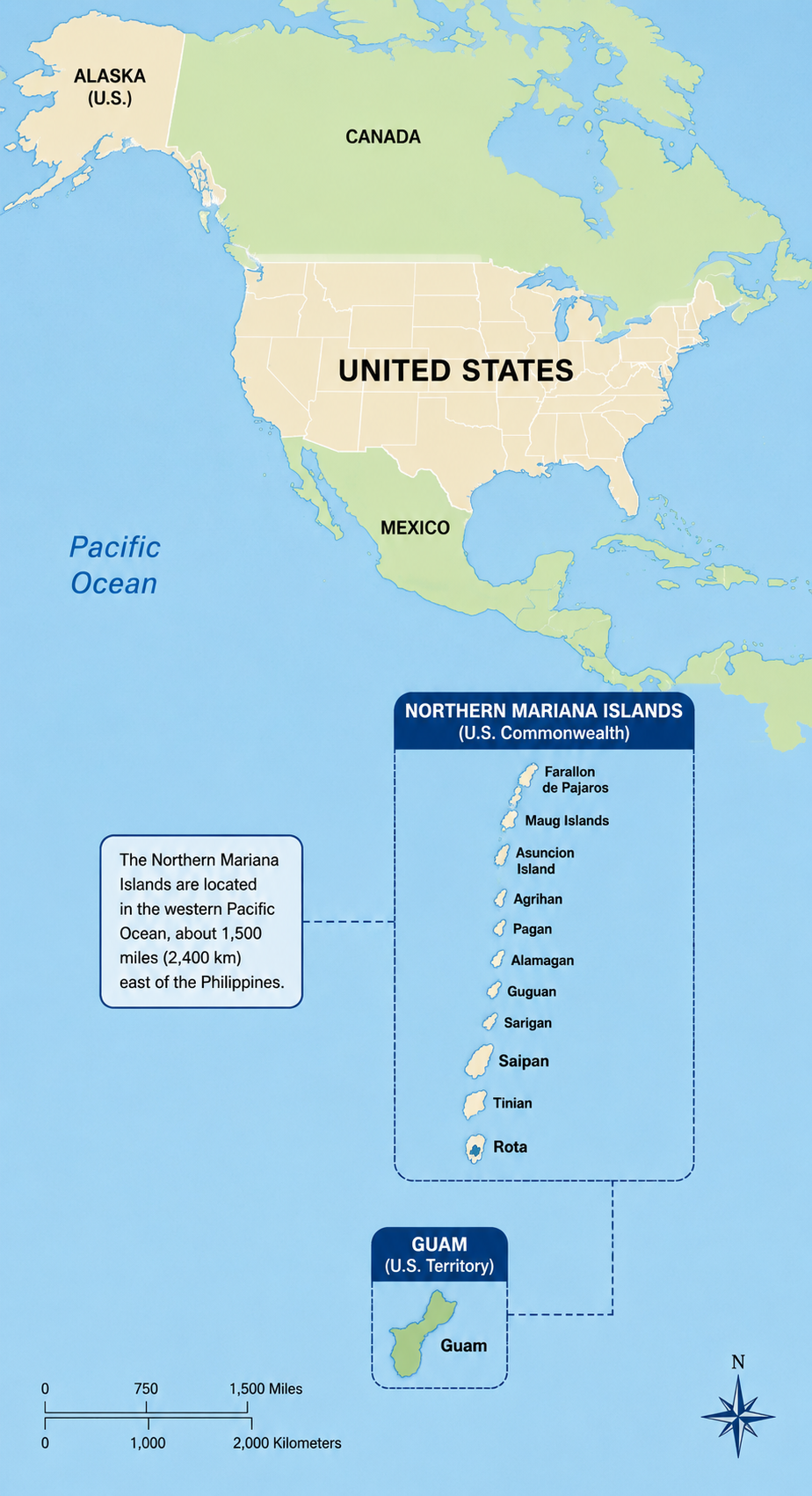
The federal government has taken another step toward potentially allowing deep-sea mineral exploration and extraction in federal waters offshore the Commonwealth of the Northern Mariana Islands (CNMI), prompting renewed concern from Indigenous community advocates, conservation organizations and officials across the Mariana Islands.
The Marine Minerals Administration (MMA), part of the U.S. Department of the Interior, announced that it has published a Proposed Leasing Notice (PLN) outlining terms for a potential critical-minerals lease sale in the Pacific waters surrounding the CNMI.
The proposed action does not authorize mining or guarantee that a lease sale will occur. However, it represents a significant advancement in a federal process that could eventually allow companies to explore and potentially collect seabed minerals.
The proposed leasing area is in federal waters east of the Mariana Trench National Marine Monument. Federal documents identify potential deposits including polymetallic nodules and ferromanganese crusts, which can contain minerals such as cobalt, nickel and manganese. The area under consideration includes extremely deep waters, with depths previously identified by the federal government ranging from roughly 3,700 to 25,100 feet.
MMA Acting Director Matt Giacona said the minerals are important to U.S. national security, manufacturing and energy technologies.
The agency said the Proposed Leasing Notice identifies potential lease blocks, proposed lease conditions and other information for prospective bidders. It also completed an Environmental Assessment examining potential impacts associated with issuing commercial leases and allowing preliminary activities.
Federal officials emphasize that a lease, if eventually issued, would initially allow activities such as environmental characterization and scientific surveys rather than automatically authorize commercial mining. BOEM's earlier description of the process said preliminary activities could include geological and geophysical surveys, biological sampling and oceanographic measurements.
The next major decision would be whether the federal government proceeds to a Final Leasing Notice. If it does, federal officials say that notice would be published at least 30 days before a potential sale.
First Nations Citizens Communities raise concerns.
The federal announcement comes after months of opposition from Indigenous community advocates and conservation organizations throughout the Mariana Islands.
The First Nations Citizens of the Marianas include the Chamorro and Refaluwasch (Carolinian) Communities, whose cultural, subsistence, and historical relationships with the ocean are central to opposition expressed by local advocates.
Friends of the Mariana Trench, a grassroots organization based in Saipan, has repeatedly criticized the federal process and called for greater participation by Residents. The organization has described the waters surrounding the Mariana Trench as part of the ancestral homeland of the Chamorro and Refaluwasch peoples.
Sheila Babauta, chair of Friends of the Mariana Trench and a former CNMI lawmaker, has argued that protecting the ocean is inseparable from protecting Mariana culture and identity.
Babauta has said the relationship between Mariana communities and the ocean extends beyond environmental concerns, describing the ocean as part of the community's ancestral heritage and emphasizing the need to protect marine resources for future generations.
Local First Nations Advocates have also questioned whether federal agencies have provided meaningful opportunities for communities to participate in decisions involving waters that have cultural and traditional significance.
In January, Friends of the Mariana Trench and the Micronesia Climate Change Alliance were among organizations supporting a petition calling for an immediate halt to deep-seabed mining proposals in the Marianas and American Samoa. The groups called for community-led decision-making and said Indigenous peoples should have a meaningful role in decisions affecting their ocean environments.
More than 60,000 petitions, letters and public comments opposing deep-sea mining proposals in the region were reported by participating organizations during the earlier federal public-comment process. Friends of the Mariana Trench, Micronesia Climate Change Alliance and Tåno, Tåsi, yan Todu were among the organizations involved in the campaign.
Environmental groups warn of unanswered questions.
Environmental organizations say the federal government is moving toward commercial leasing despite significant scientific uncertainty about deep-ocean ecosystems.
Friends of the Mariana Trench have called for greater transparency and public hearings, while conservation organizations have questioned whether enough is known about the biological, ecological and cultural resources that could be affected.
At a 2026 Mariana Islands Conservation Conference, representatives from Friends of the Mariana Trench, Tåno, Tåsi, yan Todu, the Micronesia Climate Change Alliance, the Blue Nature Alliance and other organizations participated in discussions concerning the proposed mining process and scientific data gaps.
Environmental concerns are not limited to the CNMI. Greenpeace has also criticized the federal government's broader Pacific deep-sea mining initiative, arguing that deep-sea ecosystems remain poorly understood and that extraction could create long-term ecological risks.
The Natural Resources Defense Council has similarly warned that deep-sea mining could damage deep-ocean habitats and the ecosystems that depend upon them.
Guam and CNMI share concerns.
The issue also affects Guam because the proposed federal waters are part of the interconnected Mariana Islands marine ecosystem.
The governors of Guam and the CNMI previously asked federal officials for greater consultation and community engagement. Guam officials have emphasized that relatively little scientific research has been conducted on the deepest parts of the ocean and that the environmental consequences of deep-sea mining remain uncertain.
The Guam Legislature also renewed its opposition to deep-sea mining and called for a moratorium, citing potential legal, economic, social, cultural and environmental impacts.
Community advocates have raised concerns about potential effects on fisheries, traditional navigation, cultural resources and ecosystems extending beyond the immediate boundaries of a proposed lease area.
A decision that could shape Pacific waters.
The federal government argues that developing domestic sources of critical minerals could reduce U.S. dependence on foreign suppliers and strengthen supply chains for advanced manufacturing, energy technologies and defense-related industries.
Federal officials say the CNMI process includes environmental review, public participation and consultation requirements before any commercial development could be authorized. BOEM previously reported receiving more than 65,000 public submissions during the initial information-gathering process, including both support and opposition.
Opponents, however, argue that the potential economic benefits do not outweigh the risks of disturbing poorly understood deep-ocean ecosystems and culturally important marine environments.
For CNMI communities, the debate is therefore about more than mineral supply. It also involves questions of First Nations participation, cultural stewardship, environmental protection and who should have a meaningful voice in decisions involving the waters surrounding the Mariana Islands.
The Proposed Leasing Notice is a step in the federal leasing process, not a final authorization to mine. But its publication moves the issue closer to a potential lease sale—and guarantees that the debate over the future of the Mariana Islands' deep ocean will continue.
Source: U.S. Department of the Interior, Marine Minerals Administration; Bureau of Ocean Energy Management; Friends of the Mariana Trench; Micronesia Climate Change Alliance; Tåno, Tåsi, yan Todu; Greenpeace; Natural Resources Defense Council and regional public reporting.
See something that needs a correction? Email news@saulttribeguardian.com.
Our terminology from the Publisher/Editor Renee St. Andre – As a "Half-Breed" as defined in U.S. Treaties with tribal nations, and because as far as can be proven all Citizens on Earth are “Indigenous” to Earth we may refer to what others call Indigenous as First Nations Citizens when determined this group of people are the first nations descendants of that geographic area. This is done mostly to end stereotypes of what a Indigenous Person represents. Publisher - Native American Broadcasting Company.