May 6, 2026.
BOSTON— Conservation Law Foundation, Natural Resources Defense Council, the Center for Biological Diversity, and whale-watch naturalist Zack Klyver sued the federal administration to block its attempt to open the Northeast Canyons and Seamounts Marine National Monument to commercial fishing.
The monument is roughly 4,900 square miles, and its unique underwater geography supports a vibrant reservoir of ocean life. President Trump’s February proclamation allowing commercial fishing in the monument would inflict long-term damage to precious natural resources without meaningful economic benefits.
The Canyons and Seamounts is the Atlantic Ocean’s first and only marine national monument. It’s a hot spot of biodiversity, sheltering endangered whales, undiscovered deep-sea life, and cold-water corals that can take centuries to grow. Removing protections and allowing commercial fishing within the ocean monument boundaries would cause irreparable damage to its delicate life.
“Conservation Law Foundation campaigned to establish this monument because the life it shelters is unique and irreplaceable. The last time the Trump administration tried to strip away protections, we sued and kept fighting until protections were restored. We’re ready to do it again,” said Chloe Fross, staff attorney for CLF.
President Trump briefly imperiled the national monument in 2020 when he signed a proclamation allowing commercial fishing in the area, but CLF, NRDC, the Center and Klyver sued to challenge his unlawful rollback. President Biden restored protections when he took office in 2021. Federal courts have also previously ruled that the Northeast Canyons and Seamounts was created legally in response to a challenge from fishing industry groups.
“Northeast Canyons and Seamounts is a living scientific laboratory and a refuge for species as varied as cold-water corals and sperm whales. Only the Trump administration would think it makes sense to open it up to damage and harm from commercial fishing,” said Devon Flanagan, a senior attorney at NRDC. “That decision is clearly unlawful, and we will be fighting it in court until we win.”
The lawsuit, filed Monday, says Trump has no legal authority to abolish or diminish national monuments established by a prior president.
“It’s short-sighted and completely illegal for Trump to try and rob this marine monument of critical protections,” said Kristen Monsell, oceans legal director at the Center for Biological Diversity. “Atlantic whales and corals have so few refuges off our coast, they can’t afford to battle it out with commercial fishing operations in one of their only protected areas. We’re not going to accept this abuse of power and threat to imperiled marine life.”
“I have taken over 750,000 people out on the ocean to see wildlife, so I know how important it is to protect this marine monument. My business depends on a healthy ocean,” said Zack Klyver, co-chair of the North Atlantic Whale Watch Naturalist Association. “Trump’s attack on New England’s only marine monument is one I take personally. We need to protect our oceans and their abundance of marine life if future generations are to experience them.”
The background.
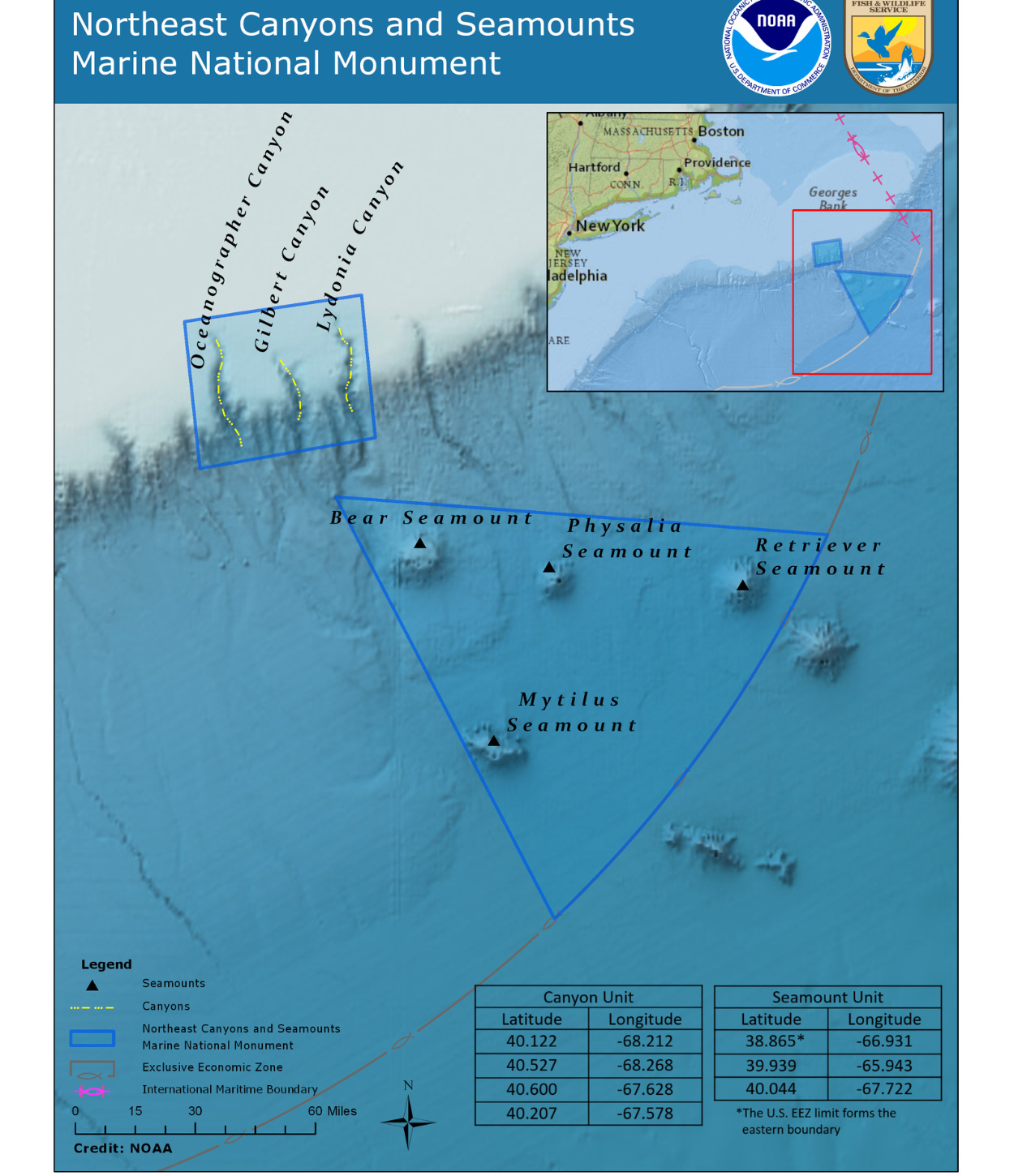
On September 15, 2016, President Barack Obama established the Northeast Canyons and Seamounts Marine National Monument by Presidential Proclamation 9496 (81 FR 65159), under the authority of the Antiquities Act of 1906. The Monument is located about 130 miles off the coast of Cape Cod, Massachusetts, and is approximately the size of Connecticut (4,913 square miles). It is the first and only marine national Monument in the Atlantic Ocean. The Monument protects fragile and largely pristine deep-sea environments alive with marine animals. Protecting this unique area as a national Monument will safeguard it for future generations.
The U.S. Fish and Wildlife Service (USFWS), in the Department of Interior, and NOAA, in the Department of Commerce, jointly manage the Monument. The Monument includes the waters and submerged lands within two Units – a Submarine Canyons Unit and a Seamounts Unit.
Submarine Canyons Unit.
There are three undersea canyons within the Monument. These canyons are among the largest of about 35 major undersea canyons that line along the U.S. continental shelf edge from Cape Hatteras north to the Canadian boundary. From the lip of Oceanographer Canyon to its deepest location, the canyon is approximately 1,220 meters (4,000 feet) deep—this is the average depth of the Grand Canyon.
These canyons are cut into the continental slope and lower continental shelf. They have steep walls and are largely formed by erosion on the continental slope.
Upwellings of deep, cold water around the canyons bring nutrients to support large quantities of plankton, krill, forage fish, and schools of squid, which in turn, nurture high abundances of large marine animals such as whales, dolphins, and large migratory fish.
Seamounts Unit.
During a 2013 expedition along the northeast U.S. Atlantic coast, scientists observed that corals were diverse on Mytilus Seamount, but composition and abundance of corals differed between the north and south side of the seamount. Image courtesy of the NOAA Office of Ocean Exploration and Research, Northeast U.S. Canyons Expedition 2013. Download image (jpg, 1.6 MB).

There are four undersea mountains or seamounts within the Monument: Bear, Physalia, Retriever, and Mytilus seamounts. The seamounts are steep undersea extinct volcanoes. These seamounts are part of the New England seamount chain that resulted from a mantle-plume hotspot. This same mantle-plume hotspot created New Hampshire’s White Mountains as it migrated eastward under the North American Tectonic Plate. The Monument’s seamounts rise thousands of feet from the ocean floor, comparable to the height of the Appalachian Mountains. They are largely conical in shape, although wave erosion over time has caused some (e.g., Bear and Mytilus) to have a plateaued summit. Seamounts with a flattened top are referred to as “guyots.”
The seamounts are considered “biological islands in the deep sea.” They are ideal incubators for new life because of their isolation, unique topography, and current patterns. As currents flow up and around the seamounts, eddies can form, helping to keep larvae and other small organisms positioned over the seamount. In addition to encouraging larval settlement, these currents also bring food to the filter-feeding corals and sponges that grow in abundance here. Like the canyons, the substrate on these seamounts varies widely, resulting in a variety of species being found close together, leading scientists to refer to the seamounts as “ocean oases.”
Biodiversity within the Monument.
The Monument is renowned for its rich and unique biodiversity, including deep-sea coral ecosystems and concentrations of marine wildlife. Its geographic features result in oceanographic conditions that concentrate pelagic or ocean-dwelling species, including whales, dolphins, and turtles, as well as highly migratory fishes such as tunas, billfish, swordfish, and sharks. A large number of seabirds also rely on this area for foraging, including Atlantic puffins. Source NOAA 2019