
May 8, 2026.
The Washington Post reports that the expansion of the wall along the southern border with Mexico has damaged a rare Native American archaeological site in the Arizona desert, area residents said Thursday, as the administration moves to rapidly build hundreds of miles of additional barriers in a $46.5 billion project.
The aggressive expansion project — funded by the One Big Beautiful Bill — is erecting three miles of wall a week, introducing barriers in parts of Texas that did not previously have them, as well as a second wall in much of California, Arizona, and New Mexico.
According to many groups the construction is not abiding by environmental laws and other protections, alarming advocates, national park staff and Native Americans. It appears the tribes on the Southern Border may not have the resources needed to fight these changes in Federal Court.
In Arizona, construction crews ran heavy machinery through and destroyed a roughly 60-to-70-foot swath of an intaglio, a more than 200-foot-long ground etching that looks like a fish and is thought to be at least 1,000 years old, said Richard Martynec, a retired archaeologist who now volunteers his time surveying the area.
Satellite imagery showed a disturbance crossing the intaglio area.
An Elder of the Hia-ced O’odham Indigenous people, reported the damage.
The intaglio is inside Cabeza Prieta National Wildlife Refuge, where a government contractor overseen by Customs and Border Protection has been working on the barrier project for weeks. The Interior Department administers the refuge.
An Interior Department Staffer, who spoke on the condition of anonymity because they were not authorized to talk to the media, confirmed the intaglio had been damaged.
The primary goal of the wall “is to gain operational control of the border,” the CBP website states. “These border barriers are intended to provide persistent impedance and denial to illegal cross-border activity.”
The Department of Homeland Security has issued waivers so that border wall construction does not have to follow laws that protect the environment or First Nations Sites, which normally require extensive study and planning to limit damages.
Most of the refuge is already separated from Mexico by a single wall, with the administration building a second parallel wall in a bid to increase security.
Martynec found the intaglio in archaeological surveys of the area with his wife, also an archaeologist, in 2002.
While there are other intaglios near the Colorado River, this etching is unique for southwestern Arizona. “There are very few intaglios in this area, so by losing part of it, it’s a big deal,” Sandra Martynec said.
Native Americans made the intaglio by scraping the blackened stones on the ground to lay bare the white soil beneath, Richard Martynec said. It was probably used for ceremonies, although that and the intaglio’s exact age are hard to know.
Richard Martynec said he had visited the site about two weeks ago and saw stakes running through the intaglio and extending in both directions, appearing to mark the future path of the border wall.
There were no tire tracks leading up to the stakes, indicating that whoever placed them chose not to drive through the area.
“They knew something special was there,” he said.
At the time, construction seemed distant, he said, so he did not alert anyone to try to stop it. He had heard that government officials were actively discussing with locals how to mitigate any damage.
Native American residents, including the nearby Tohono O’odham Nation, have expressed concerns about other significant sites that lie in the path of proposed border wall construction. Those include Quitobaquito Springs, which is also home to endangered turtle and fish species, in Organ Pipe Cactus National Monument, as well as a Native American grave site.
In Texas, The Center for Biological Diversity, Friends of the Ruidosa Church, and a Big Bend-area river guide and landowner sued the Department of Homeland Security for unconstitutionally waiving dozens of laws to fast-track border wall construction through the Big Bend region of Texas. The lawsuit argues the department is exercising powers Congress never authorized.
“The Department of Homeland Security has unconstitutionally gutted our nation’s bedrock environmental laws to build a wildlife-killing wall that would permanently lock away the Rio Grande,” said Laiken Jordahl, national public lands advocate at the Center for Biological Diversity. “This is straight out of the playbook they used in Arizona, where federal contractors blew up sacred Indigenous sites, bulldozed canyon walls and drained precious aquifers to build border walls. They’re trying to slam an iron curtain through the Big Bend region, gouging a wound that will never heal into one of America’s most beautiful wild places.”
A border wall would sever public access to the Rio Grande, devastating the region’s river outfitters, its recreation economy, dark skies, and natural and cultural heritage. It would also split wildlife populations, including black bears and Carmen Mountains white-tailed deer, leaving populations isolated and vulnerable to decline.
“This place isn’t just where I work, it’s where I’ve built my life and raised my kid. We call the Rio Grande our cathedral,” said Billy Miller, a professional river guide and landowner in Redford, Texas. “I’ve spent more than two decades guiding on the river, and if a border wall cuts off access, that’s the end of my career. No one comes to Big Bend to see steel walls and razor wire. If they build this, they’re not just destroying a landscape, they’re wiping out our way of life.”
The lawsuit, filed in U.S. District Court in the Western District of Texas, argues the federal government violated several constitutional provisions, including the major questions doctrine, which requires clear congressional approval for actions with vast economic and political consequences.
The Department of Homeland Security waived dozens of laws that protect clean air and water, public lands, wildlife, and historic resources to build a cross-continental wall along the entire southern border. Because the Big Bend waiver advances that broader, highly consequential project without explicit approval from Congress, the lawsuit argues it is unconstitutional.
“The federal government is operating with zero regard for the damage a new border wall would bring to Big Bend,” said Rochelle M. Garza, president of the Texas Civil Rights Project. “If the moves DHS has publicly made can be deemed unconstitutional, that inspires little confidence in the ethics of decisions being made behind closed doors. On behalf of all who enjoy its grandeur, Big Bend locals and advocates are demanding clarity and fighting to protect the lands they know best.”
Last week the Center and Texas Civil Rights Project filed a separate lawsuit over the government’s refusal to release basic records on border wall plans in the region.
“Ruidosa Church has stood for generations, but it was never built to withstand the industrial shock-waves border wall construction would bring,” said Jordan Martinelli with Friends of the Ruidosa Church. “Wall construction would industrialize this remote stretch of the Rio Grande and place one of the region’s most beloved historic structures in harm’s way. It’s being fast-tracked by waiving laws like the National Historic Preservation Act, stripping this church of the legal protections every other historic site in the country is guaranteed.”
In October 2025 the department waived federal procurement laws for border construction across the entire U.S.-Mexico border, including Big Bend Ranch State Park and Big Bend National Park. In February 2026 the agency issued a separate waiver of environmental, cultural resource and other laws to fast-track wall construction in the Big Bend region.
The federal government has since awarded construction contracts, including a $1.2 billion contract to North Dakota-based Fisher Sand and Gravel. The company has paid millions of dollars in penalties for numerous environmental violations.
Local media have reported that contractors surveyed land inside Big Bend National Park and Big Bend Ranch State Park, and residents have documented crews installing survey stakes for wall construction in the state park and nearby areas. Customs and Border Protection has repeatedly revised its online maps and issued conflicting statements about whether walls would be built in the parks.
In late February the agency released planning maps showing border walls along every accessible stretch of the Rio Grande in both parks. After bipartisan outcry from local sheriffs, residents, elected officials and business leaders, Customs and Border Protection revised those maps. Updated versions removed physical wall segments from the parks and replaced them with “detection technology,” an undefined term, while still targeting hundreds of miles of border for walls upriver from the parks. The agency has said barriers in the parks are “still in the planning stages,” signaling it could move ahead without public notice, input or congressional approval.
The lawsuit also challenges Homeland Security’s claim that the Big Bend Sector is an “area of high illegal entry,” noting that it has the lowest number of crossings along the southern border and historically low apprehensions. The sector covers roughly a quarter of the border but accounts for just 1.3% of all Southwest border apprehensions.
In March more than 130 organizations, outfitters and rural Texas businesses urged Congress to block federal funding for border wall construction in the Big Bend region.
The plaintiffs are represented by attorneys at the Center for Biological Diversity and Texas Civil Rights Project.
In New Mexico Contractors blasted the south side of Mount Cristo Rey to prepare the terrain for construction of the border wall.
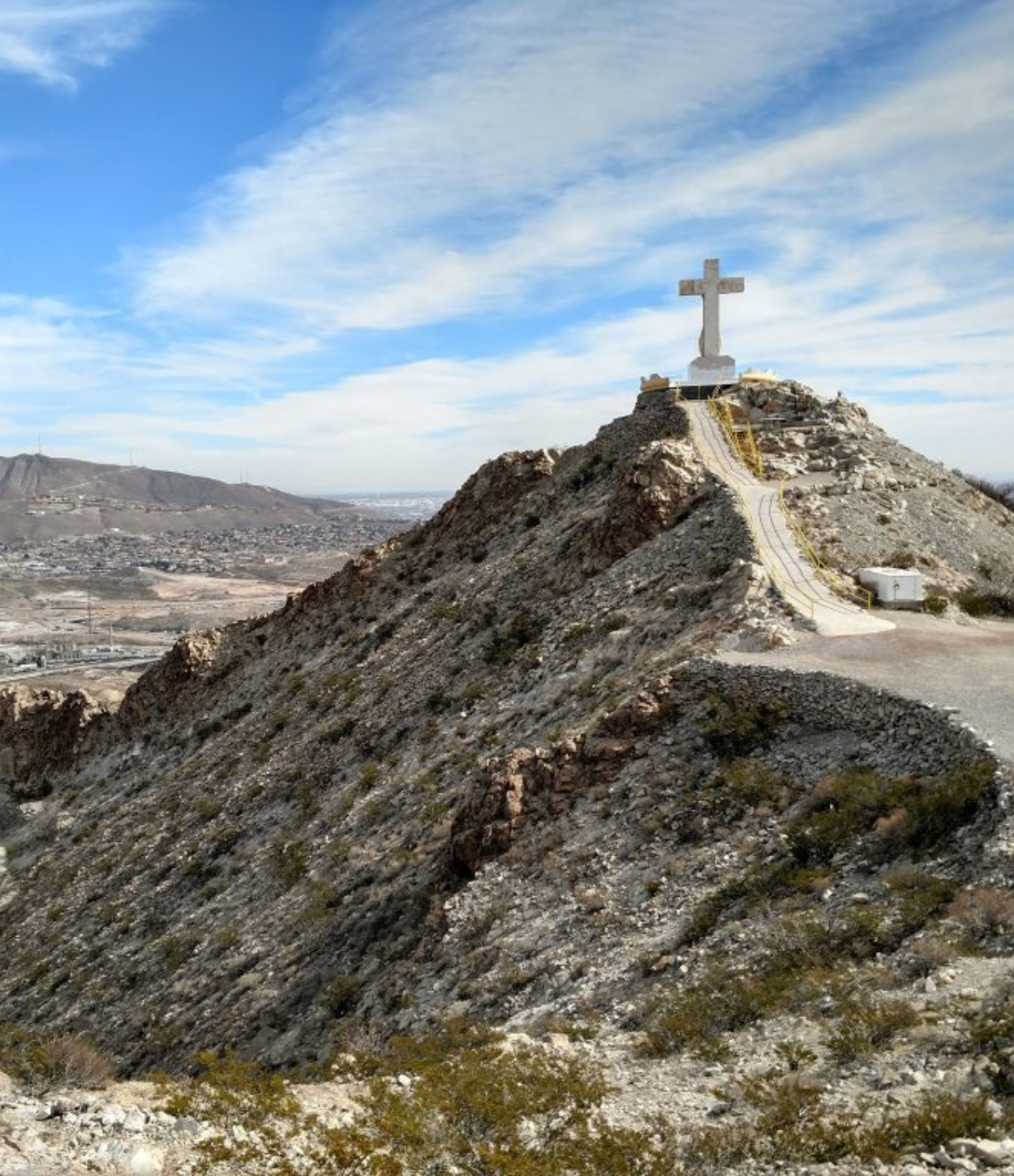
Walls have long separated El Paso and Sunland Park, New Mexico, from the Mexican metropolis of Ciudad Juárez. But building a wall on the rugged slopes of Mount Cristo Rey was long considered impractical. Eventually, the mountain’s slopes became the only significant gap without an imposing border fence in the binational metro area of more than 2.5 million people.
SLSCO, a Texas company based in Galveston, has a $95 million contract to build a 1.3-mile wall on Mount Cristo Rey and two other barriers near El Paso. CBP waived environmental and historical preservation laws in June 2025, clearing the way for a border wall on the mountain. Over the objections of the local Catholic diocese, which owns most of the mountain, work began at the site in January.
Locals believe “There is no accountability,”... “And the damage will be irreparable.”
“CBP claims that they have environmental monitors present during these activities to ensure construction best management practices are being followed and implemented by the construction contractor”.
However an environmental summary report, completed in place of an environmental impact assessment, is not available to the public, the spokesperson said.
High Country News reports that the then-Homeland Security Secretary Kristi Noem waived more than two dozen laws on June 3, 2025 to expedite construction of the wall across the mountain. The REAL ID Act of 2005 granted DHS the authority to “waive all legal requirements” necessary to expedite construction of border barriers. Among the laws waived were the National Environmental Policy Act and the National Historic Preservation Act.
CBP announced plans for a 30-foot-high barrier that would run along the south side of the mountain and loom over the Anapra neighborhood in Ciudad Juárez. Agency plans state the wall will consist of steel bollards spaced four inches apart. It will require drainage gates and access roads.
Funding for CBP’s El Paso Anapra 16-4 Wall Project, which includes Mount Cristo Rey, dates back to the DHS 2020 border wall appropriations. Since then, the agency has received 224 written statements about the proposal. According to the summary, 211 comments opposed the wall.
Notably, the Roman Catholic Diocese of Las Cruces urged the agency to exclude Mount Cristo Rey from its barrier plans. In its comments, the diocese referred to the mountain as a place “where faith transcends borders.”
“A grant of entry onto land [the diocese] owns for CBP purposes, whether temporary or permanent, would deter those pilgrims and migrants from exercising their religion as they have done for almost one hundred years,” wrote the Diocese’s general counsel, Kathryn Brack Morrow. “A place of hope, faith and communion would become a place of fear, exclusion and division.”
Morrow wrote that the diocese had received multiple requests from the Justice Department for access to its property, which were denied.
To the untrained eye, Mount Cristo Rey, like many Chihuahuan Desert locales, can appear desolate. A local CBP spokesperson compared it to a “moonscape” in a local news interview. “It’s just rock and sand.”
But for geologists like Eric Kappus, Mount Cristo Rey is a “treasure.”
Kappus discovered a series of dinosaur footprints at Mount Cristo Rey in 2002 while he was a graduate student at the University of Texas at El Paso. The prints were formed between 80 and 100 million years ago when Iguanodons and theropods plodded through mud on the edge of what was then a vast sea.
Kappus said he spent thousands of hours exploring Mount Cristo Rey, looking for fossils and prints. After working as an exploratory geologist and teaching across the country, he still considers it one of the premier sites anywhere for geology education.
“I could teach 75 to 80% of an introductory geology class in the field at Mount Cristo Rey,” he said. “It’s like a giant chalkboard.”
“This mountain is very unique,” he said. “But there hasn’t been a lot of scientific research done here.”
The prints, preserved in sandstone, were exposed during excavation for the brick yard. The site was later donated to the non-profit INSIGHTS El Paso Science Center.
However the dinosaur tracks site is not threatened by border wall construction.
In their public comments to CBP, more than 80 people expressed concern for Mount Cristo Rey’s prized environment. The agency’s summary statement, in response, explained that a biological survey yielded no federally listed threatened or endangered species. The survey deemed that the habitat has a “low to moderate” suitability for wildlife.
“CBP has also determined there is minimal impact to vegetation and behavioral patterns of wildlife since the project area is flanked by existing barriers and an active patrol road,” the agency wrote.
Ardovino, the local business owner, said that wildlife activity in Sunland Park diminished after Border Patrol was “unleashed” to drive across the desert and carve new roads.
Years ago, he said, there were 18 pairs of burrowing owls, a diminutive variety, on his property. That was until Border Patrol vehicles repeatedly disrupted their habitat.
“They’re gone now,” he said. “Concern for the environment is last on [the CBP] list.”
Myles Traphagen coordinates the borderlands project of the Wildlands Network, a non-profit advocacy group. He said building the border wall will counteract federal efforts to foster endangered species, including the Mexican gray wolf.
U.S. and Mexican government biologists collaborate on wolf reintroduction, with pups from New Mexico transported to northern Mexico to grow the population and increase genetic diversity.
“The border wall is quite disrespectful to a lot of work that’s been undertaken by numerous government agencies,” he said.
In 2017, Traphagen tracked the movements of a Mexican gray wolf outfitted with a GPS collar. The wolf traveled north from Chihuahua into New Mexico, then followed the Rio Grande to Mount Cristo Rey, where it crossed back into Mexico.
He said the border wall will close off this wildlife crossing point.
It appears the best hope for those that value the environment more than money is a Mid-Term Win for Democrats. If the Democrats don't take control of the Senate and Congress the damage done to our planet by the current federal government leaders will take decades to recover if ever.
"It appears" the Republicans know they are not going to win the mid-terms and are attempting to by-pass as many regulations as possible to get their way like a bunch of entitled brats" is what many believe. What the current administration may not grasp is that their behavior may lead to them never having control of the house and senate again. They are losing Independent Voters that won't forget their behavior. They most likely will pinch their nose and still vote Democrat even if they hate them.
Cover Photo Credit: Center for Biological Diversity. Mt Cristo Photo On-line Open Source.
Click hear for advertising rate information and disclosures.

