November 28, 2026.
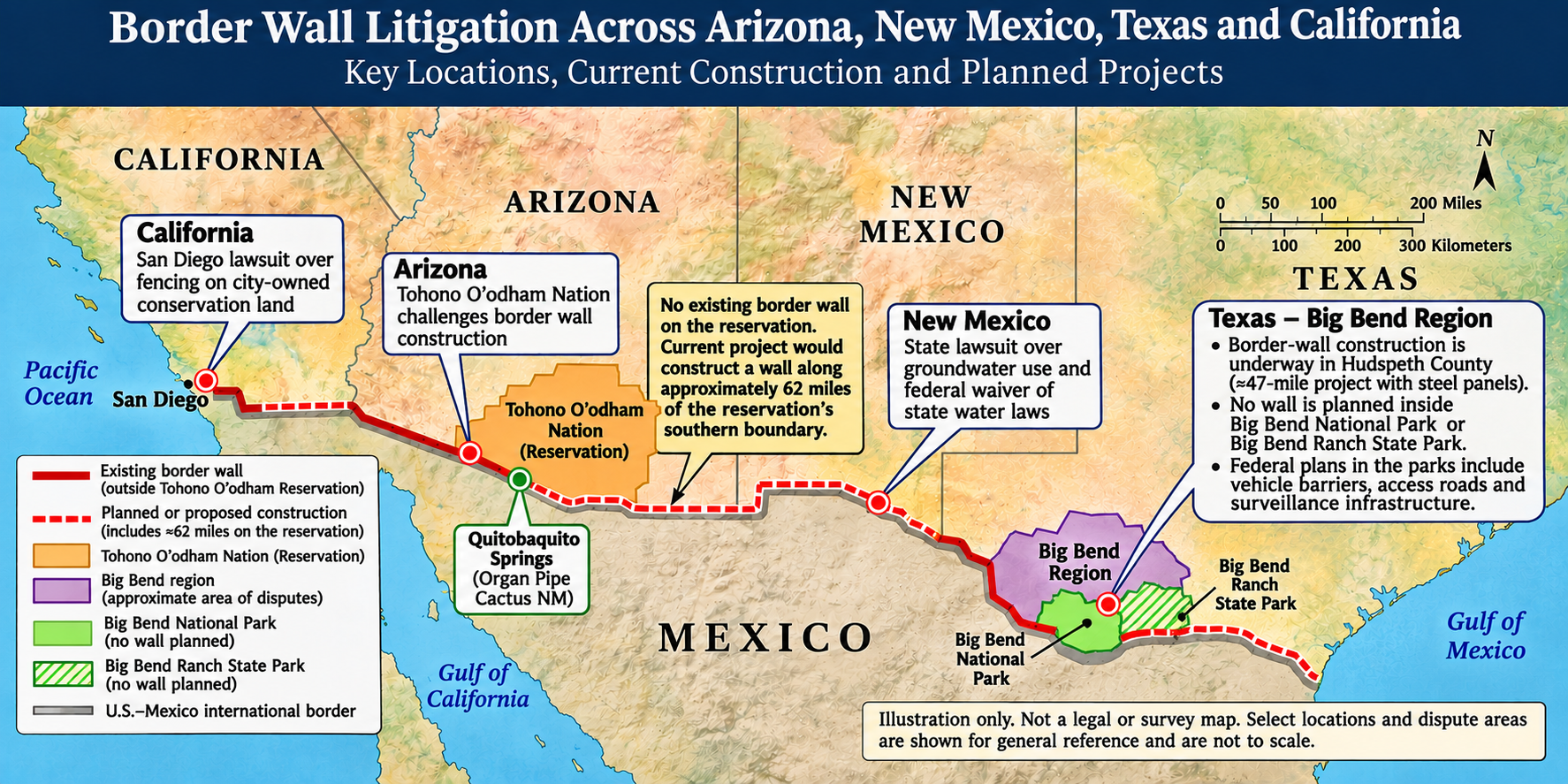
Lawsuits in Arizona, Texas, New Mexico and California challenge federal border construction, raising questions about Tribal sovereignty, cultural resources, private property and state authority.
Federal border-wall expansion along the U.S.–Mexico border is generating legal disputes across Arizona, Texas, New Mexico and California. The cases involve more than the construction of physical barriers. They raise questions about Tribal sovereignty, ancestral homelands, federal authority, cultural and religious protections, groundwater rights, private property, environmental laws and the responsibilities of state and local governments.
The legal challenges are unfolding in different courts and involve different claims. The Tohono O’odham Nation in Arizona is challenging federal construction along its southern reservation boundary. In Texas, conservation organizations, landowners and cultural groups are contesting construction in the Big Bend region. New Mexico is challenging federal contractors' groundwater use and the federal government's attempt to waive state water laws. In California, San Diego is challenging federal fencing activities on city-owned conservation land, while a separate federal case concerns temporary access to property for border infrastructure surveys and investigations.
Although these cases are not consolidated, their outcomes could help define the limits of federal authority over land, water, cultural resources and local jurisdictions along the international border.
Arizona: Tohono O’odham Nation challenges border construction.
The Tohono O’odham Nation is pursuing legal action against the federal government's plans to construct approximately 62 miles of primary border wall along the southern boundary of its reservation in Arizona.
The dispute involves the federal government's reliance on the Roosevelt Reservation, a 60-foot strip of land established through a 1907 presidential proclamation along the U.S.–Mexico border. Federal officials maintain that the proclamation provides authority over public lands within that strip. The Nation disputes the government's position and argues that construction and associated activities threaten its reservation property and jurisdiction.
The Nation also argues that construction activities will extend beyond the immediate border strip, requiring staging areas, material storage, equipment parking, concrete facilities and other infrastructure that could disturb additional reservation land.
An October 28, 2026, complaint against contractor SLS Federal Services alleges that the company and its subcontractors used interior reservation roads without authorization to reach construction areas and conduct pre-construction activities. These are allegations in the Nation's complaint, not findings by a court.
The contractor lawsuit is Tohono O’odham Nation v. SLS Federal Services LLC, Case No. 4:26-cv-00574-TUC-SHR, in the U.S. District Court for the District of Arizona.
The Arizona Daily Star reported November 27 that SLS received a $1.3 billion contract to construct approximately 62 miles of primary border wall. The contract lists a potential award amount of up to $2.2 billion. The higher figure represents a potential contract amount, not confirmation that the full amount has been spent or paid.
The Nation estimates that approximately 4,000 cacti and other plants could be affected by the project. That figure is the Nation's estimate, not an independently verified final count.
Ancestral homeland is not the same as the present-day reservation.
An important part of the Nation's legal and cultural position concerns the distinction between its ancestral homeland and its present-day reservation.
The Tohono O’odham ancestral homeland extends beyond the boundaries of the reservation established in the United States. As described in the October 28 complaint and reported by the Arizona Daily Star, traditional lands extend south toward Hermosillo, Sonora, and west toward Mexico's Sea of Cortez.
The international boundary divided O’odham communities and traditional lands. It did not eliminate the Nation's historical, cultural and family connections across the border.
The Nation's October 28 complaint describes the potential consequences of a permanent border structure. That statement is the Nation's legal argument, not a judicial determination that the federal government has unlawfully taken reservation land.
The distinction matters because the Nation's ancestral homeland is much larger than its current reservation. The existence of an international boundary and the establishment of a reservation did not erase the historical connections of O’odham communities in what are now Arizona and Sonora.
The dispute therefore involves both the Nation's asserted property and jurisdictional rights within its reservation and its broader concerns about the division of traditional lands and communities.
December 1 appellate arguments.
The Nation's appeal is pending before the U.S. Court of Appeals for the District of Columbia Circuit in Tohono O’odham Nation v. Mullin, Appeal No. 26-5306. The underlying district court case is No. 1:26-cv-02127, in the U.S. District Court for the District of Columbia.
The Arizona Daily Star reported November 27 that the appeals court denied the Nation's November 25 emergency request to halt construction while the appeal proceeds. The newspaper described the order as unsigned and reported that the court concluded the Nation had not satisfied the requirements for an injunction pending appeal.
That ruling did not decide the underlying appeal or resolve the broader dispute over reservation boundaries and federal construction authority.
In a November 26 statement, the Nation announced that its attorneys would appear before the D.C. Circuit on December 1 to present their legal arguments. Chairman Verlon Jose and members of the Nation's Border Security Delegation also planned to attend.
The appeal has drawn friend-of-the-court briefs from the National Congress of American Indians, the Inter-Tribal Association of Arizona, the Salt River Pima-Maricopa Indian Community, the Ak-Chin Indian Community, the Center for Biological Diversity and other organizations. Their participation does not make them parties to the lawsuit.
The contractor lawsuit against SLS Federal Services is separate from the Nation's appeal against federal officials. One concerns alleged unauthorized access and pre-construction activity; the other challenges federal government actions and authority.
Quitobaquito Springs: Cultural and environmental concerns.
Another area of concern is Quitobaquito Springs, located within Organ Pipe Cactus National Monument in southwestern Arizona, close to the international boundary.
The springs are outside the present-day Tohono O’odham reservation but are part of a cultural landscape with historical connections to O’odham peoples, including the Hia-Ced O’odham.
Quitobaquito is an important desert water source and supports rare wildlife, including the endangered Quitobaquito pupfish and Sonoyta mud turtle. The area also contains archaeological and cultural resources.
Construction preparations for additional border infrastructure near the springs have raised concerns among conservation organizations and members of O’odham communities.
Photographs and reporting from September 2026 documented bulldozers and construction activity near the springs. Arizona Public Media reported that the spring itself appeared untouched during a September flyover, although work was visible in the surrounding area.
The distinction is important: photographs of construction activity near Quitobaquito should not be represented as proof that the springs themselves have been destroyed or that a second wall has already been completed at the location.
The concerns involve potential impacts to water resources, cultural sites, wildlife habitat and the surrounding landscape.
Texas: Big Bend disputes involve environmental laws, cultural access and private property.
In Texas, several separate lawsuits challenge federal border-wall plans and related infrastructure in the Big Bend region.
The area includes Big Bend National Park, Big Bend Ranch State Park and surrounding public and private lands. The legal disputes involve different projects and claims, and not every proposed barrier is a conventional steel bollard wall.
Friends of the Ruidosa Church v. Mullin.
One of the most consequential cases involves Friends of the Ruidosa Church, the Center for Biological Diversity and other plaintiffs challenging federal waivers of environmental and other laws for border construction.
The lawsuit is Friends of the Ruidosa Church et al. v. Mullin et al., Case No. 3:26-cv-01099, in the U.S. District Court for the Western District of Texas.
The lawsuit concerns the government's use of Section 102 of the Illegal Immigration Reform and Immigrant Responsibility Act to waive certain legal requirements for border barriers and related roads.
On October 2, 2026, U.S. District Judge Kathleen Cardone issued a preliminary injunction restricting construction covered by the order unless the government complied with applicable laws.
The federal government appealed and sought relief from the Supreme Court.
On November 9, the U.S. Supreme Court stayed the preliminary injunction, allowing covered construction to proceed while the federal government's petition for certiorari is filed and considered, if timely submitted. The related Supreme Court proceeding is Mullin v. Friends of the Ruidosa Church, No. 26A560. Justice Ketanji Brown Jackson would have denied the stay.
The Supreme Court's order discussed the limits on judicial review under Section 102 and the distinction between constitutional and statutory claims. It was a ruling on the stay request, not a final decision resolving every underlying claim in the lawsuit.
The case is important because it concerns the extent to which federal officials can use statutory waivers to bypass environmental and other legal requirements for border infrastructure.
Conserve Big Bend v. Department of Homeland Security.
A separate lawsuit was filed September 14, 2026, by Conserve Big Bend and six area landowners in the U.S. District Court for the District of Columbia.
The case is Conserve Big Bend et al. v. Department of Homeland Security et al., Case No. 1:26-cv-03198.
The plaintiffs challenge federal plans for border walls and related infrastructure in the Big Bend region, raising concerns involving government authority, private property and environmental consequences.
On November 11, plaintiffs filed a joint motion requesting a scheduling order. The publicly accessible docket information reviewed for this article did not establish a subsequent hearing date or ruling.
People of La Junta for Preservation v. Department of Homeland Security
Another Texas lawsuit involves cultural and religious protections.
The case is People of La Junta for Preservation et al. v. Department of Homeland Security et al., Case No. 5:26-cv-05245, in the U.S. District Court for the Western District of Texas.
People of La Junta for Preservation and other plaintiffs have challenged border construction that they say threatens culturally significant places and access for religious and spiritual practices.
The case raises claims under federal religious-freedom protections, including the Religious Freedom Restoration Act.
The People of La Junta is a nonprofit organization associated with the Lipan Apache community. It is not the government of a federally recognized Tribal Nation. Individual plaintiffs have also raised concerns involving their cultural and religious connections to the region.
On September 30, 2026, the court denied the plaintiffs' request for a temporary restraining order. That decision did not dismiss the entire lawsuit or resolve the underlying claims.
Presidio Municipal Development District v. Department of Homeland Security.
The Presidio Municipal Development District also challenged federal border-wall plans involving existing earthen levees in Presidio, Texas.
The case is Presidio Municipal Development District v. Department of Homeland Security et al., Case No. 1:26-cv-02146-RBW, in the U.S. District Court for the District of Columbia.
The district argued that construction of a border barrier system on or near the levees could interfere with flood-control infrastructure and create risks for the community. The dispute involved the federal government's application of the Rivers and Harbors Act and its authority to waive legal requirements for border construction.
On August 2, 2026, U.S. District Judge Reggie B. Walton denied the district's request for a stay and preliminary injunction.
The judge concluded that the federal government's July 2 waiver of Rivers and Harbors Act requirements defeated the district's likelihood of success on the claims before the court. The opinion also noted that the record did not establish actual impairment of the levees at the time of the decision.
The ruling did not establish that future construction could not affect the levees. It addressed the district's request for preliminary relief based on the legal claims and evidence before the court at that time.
The case demonstrates how federal statutory waivers can affect the ability of local governments to obtain preliminary court relief over border infrastructure.
New Mexico: Groundwater dispute creates another challenge to federal authority.
New Mexico has become another important location in the border-wall litigation because the dispute involves state water rights and the federal government's authority to override state regulations.
On August 26, 2026, the State of New Mexico announced that it had sued the federal government and contractors in the Sixth Judicial District Court.
The original state-court case is Elizabeth Anderson, P.E., State Engineer of New Mexico v. United States of America et al., Case No. D-619-CV-2026-00332, in the Sixth Judicial District Court, Luna County, New Mexico.
The federal government subsequently removed the lawsuit to federal court. The federal case is No. 1:26-cv-03292, in the U.S. District Court for the District of New Mexico.
The state's complaint alleges that contractors drilled wells without required state permits and diverted groundwater to support border-wall construction in the Mimbres, Hachita and Lower Rio Grande underground water basins.
The State Engineer's Office also alleged problems involving water-meter reporting and other well-related activities. The state is seeking an injunction and recovery for water it says was improperly diverted.
These allegations have not been established by a final court judgment.
Federal government attempts to waive New Mexico water laws.
The dispute escalated on October 2, 2026, when the Department of Homeland Security published a Federal Register notice purporting to waive New Mexico water laws and regulations for border construction.
The notice specifically identifies the New Mexico Water Code and certain state administrative regulations, along with other legal requirements. It invokes Section 102 of the Illegal Immigration Reform and Immigrant Responsibility Act.
New Mexico officials challenged the federal government's authority to set aside the state's water regulations. Governor Michelle Lujan Grisham and State Engineer Elizabeth Anderson argued that federal construction projects should not be allowed to bypass state protections for groundwater and water-rights holders.
The state said the federal government continued pumping from existing wells even after contractors were directed to pause drilling additional wells. That account reflects the state's position and should not be treated as a judicial finding.
The dispute is especially significant in southern New Mexico, where groundwater is an essential resource for residents, ranchers, farmers and communities.
The state's position is that groundwater regulation and permitting are necessary to protect existing water rights and manage limited underground supplies. The federal government's waiver raises a broader legal question about whether federal border-security authority can displace state water laws in the circumstances described.
The New Mexico dispute adds a distinct issue to the national border-wall litigation: whether the federal government can use its border-construction authority to bypass state groundwater permitting and water-protection requirements.
California: San Diego challenges federal fencing on city-owned conservation land.
California has a separate border-barrier dispute involving the federal government's use of city-owned property in San Diego County.
On January 5, 2026, the City of San Diego filed a lawsuit against the federal government in the U.S. District Court for the Southern District of California. The case is City of San Diego v. U.S. Department of Homeland Security et al., Case No. 3:26-cv-00052-AGS-BJW.
The lawsuit concerns concertina-wire fencing installed by federal personnel on city-owned property in Marron Valley, near the U.S.–Mexico border and east of Otay Mountain.
The city alleges that federal personnel entered its property without authorization and constructed fencing without the city's consent or required coordination.
The property is part of San Diego's Multiple Species Conservation Program and is subject to conservation agreements intended to protect sensitive habitat.
According to the city's complaint, the fencing and related activities interfere with city access and management of the property and threaten protected habitats, riparian areas and vernal pools. The city also raised concerns about wildlife, including the endangered least Bell's vireo and fairy shrimp that depend on seasonal pools.
The city is seeking legal relief based on claims that include trespass, public nuisance, violations of the Administrative Procedure Act and an unconstitutional taking of property.
These are allegations in the city's complaint, not findings that the federal government has been held liable.
Status of the San Diego lawsuit.
The original city lawsuit was placed on a joint stay in March 2026. A further joint request to continue the stay was granted in June.
An October 1, 2026, joint status report stated that the parties continued to request that the original lawsuit remain stayed. The report also identified a separate federal condemnation action filed September 24.
The original lawsuit remains distinct from the condemnation case. The stay does not mean that the city has lost its claims or that the dispute has been resolved.
Separate federal condemnation case seeks temporary access.
The federal government filed a second case, United States v. 1,850.18 Acres of Land et al., Case No. 3:26-cv-05490-DMS-GC, in the U.S. District Court for the Southern District of California.
The September 24, 2026, complaint in condemnation seeks a temporary, assignable easement for surveying, testing and investigative work on property in the area. The case identifies 1,850.18 acres associated with 13 parent parcels. The acreage refers to the parent tracts; the mapped proposed work areas are smaller.
The requested easement would last 12 months after possession is granted. The government seeks access to conduct topographic, environmental, geotechnical, biological, cultural and engineering surveys and investigations to plan possible border barriers, roads, cameras, lighting, sensors and related infrastructure.
In a November 20 declaration, a Customs and Border Protection acquisition program manager said the government expected most field activity to occur in limited areas and anticipated that much of the work would take place during the first six months.
The declaration states that the planned investigative activities would not include construction of border infrastructure, clearing vegetation, off-road vehicle use or staging heavy machinery. It describes work using personnel on foot, existing roads and handheld or tripod instruments.
However, the proposed easement itself includes authority to trim or remove vegetation or structural obstacles that interfere with the authorized work. The distinction between the declaration's description of planned activities and the broader language of the requested easement is important.
The government's filing estimates just compensation at $100, with additional damages, if any, to be determined later. That amount is the government's estimate, not a final court determination of compensation.
On November 23, the court issued an order requiring the City of San Diego and the State of California to respond to the federal government's motion for immediate possession by December 4. The government's reply is due December 11. The court vacated the previously scheduled December 18 hearing and said it would decide the motion on the papers.
As of November 28, the court had not granted the government's request for immediate possession.
The condemnation action does not mean that permanent border infrastructure has been approved or that the government has acquired all property rights it may eventually seek. It concerns the government's request for temporary access to conduct investigative work.
The California situation demonstrates that border infrastructure disputes can involve local property rights and conservation commitments, as well as broader federal authority and environmental questions.
What the disputes mean for Tribal sovereignty and federal authority.
Although the lawsuits in Arizona, Texas, New Mexico and California involve different legal claims, they raise broader questions about the reach of federal authority and the rights of communities affected by border construction.
For the Tohono O’odham Nation, the central issue is not simply whether a physical barrier should be built along the international boundary. The Nation argues that federal construction and associated activities threaten its reservation property, jurisdiction, cultural resources and connections among O’odham communities divided by the international border.
Tribal sovereignty includes the inherent authority of Tribal Nations to govern their territories and communities, subject to the legal framework governing relations between Tribal Nations and the federal government. The precise extent of that authority, and how it applies to particular federal projects, can be contested in court.
The distinction between ancestral homeland and reservation boundaries is especially important. Ancestral homelands can extend beyond present-day reservation boundaries and across international borders. Those historical and cultural connections remain significant even when modern political boundaries divide communities.
In Texas, the litigation raises questions about environmental-law waivers, religious freedom, access to culturally significant places and private property.
In New Mexico, the dispute concerns groundwater rights, state regulatory authority and the federal government's attempt to waive state water laws.
In California, the San Diego lawsuits raise questions about federal use of municipal property, temporary access rights and the city's ability to meet conservation obligations.
The legal outcomes will not necessarily be the same. Each case depends on its own facts, applicable laws, evidence and judicial decisions.
What connects the disputes is the broader question of how federal border-security projects are planned and implemented when they affect Tribal communities, state resources, local governments, private landowners, protected landscapes and cultural resources.
As the cases proceed, court decisions could help define the limits of federal authority, the availability of judicial review and the legal protections available to communities affected by border infrastructure.
For Tribal Nations, the Tohono O’odham case will be particularly significant because it places questions of reservation rights, sovereignty and the relationship between ancestral homelands and international boundaries before a federal appellate court.