October 21, 2026.
MICHIGAN — Anglers fishing the Muskegon River this fall are being asked to help researchers determine whether the river could provide alternative spawning habitat for lake whitefish, a native Great Lakes species experiencing significant population declines.
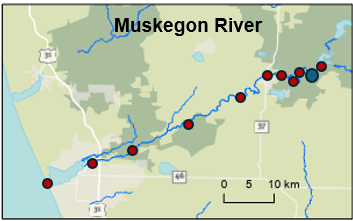
The Michigan Department of Natural Resources (DNR) and its partners will track adult lake whitefish in the Muskegon River between Croton Dam and the river mouth at Lake Michigan. The study will evaluate whether the fish can spawn in river environments and whether these habitats could help address declining populations in lakes Michigan and Huron.
Beginning in November, adult lake whitefish will be fitted with acoustic telemetry tags near their dorsal fins and released into the river. Receiver stations anchored to the river bottom will detect signals from tagged fish as they pass, allowing researchers to monitor their movements.
Anglers Asked to Report Tagged Fish.
Anglers fishing between Croton Dam and Lake Michigan should watch for lake whitefish carrying acoustic telemetry tags.
If you catch a tagged lake whitefish, release it alive whenever. possible. Anglers who harvest a tagged fish should report the catch. Anyone who finds a detached tag or notices damage to a receiver station should also contact the research team.
Reports can be made directly to:
- Scott Heintzelman, Michigan Department of Natural Resources: HeintzelmanS@Michigan.gov or 231-433-9782
- Matt Herbert, The Nature Conservancy in Michigan: mherbert@tnc.org or 517-316-2283
When reporting a tagged fish, provide the date and approximate location of the catch, whether the fish was released or harvested, and any identifying information visible on the tag. Note the tag's appearance or identification number if possible, but do not delay the fish's safe release to gather information.
Anglers, boaters and other river users should not remove tags from live fish or move receiver stations. The equipment is strategically positioned to collect data without creating navigational issues, and disturbing it could interfere with the study.
Declining Great Lakes Populations Prompt Research.
Lake whitefish are ecologically, culturally and economically important throughout Michigan and the Great Lakes region. However, populations in lakes Michigan and Huron have declined amid changes to the aquatic food web.
Habitat loss, pollution and invasive species, particularly quagga mussels, have contributed to these changes. Disruptions in food availability have threatened juvenile whitefish survival.
Matt Herbert, senior conservation scientist with The Nature Conservancy's Great Lakes Sustainable Fisheries Program, said lake whitefish stocks have declined dramatically since peaking in the 1990s. Commercial catches and yields are now at their lowest levels in three decades, according to Herbert.
Historical accounts document lake whitefish spawning runs in rivers throughout the Great Lakes. Researchers hope the Muskegon River study will establish whether the fish can resume this behavior and whether river environments offer young whitefish access to a more plentiful food supply.
Tribal Nations Join Research Partnership.
The cooperative project brings together the Michigan DNR, The Nature Conservancy, the Little River Band of Ottawa Indians, the Sault Tribe of Chippewa Indians, the Little Traverse Bay Bands of Odawa Indians, Bay Mills Indian Community and Grand Valley State University.
The findings will help researchers assess whether river habitats could supplement existing spawning areas and inform future lake whitefish conservation strategies.
Learn More.
For additional information, visit the Michigan DNR's Lake Whitefish webpage or The Nature Conservancy's Great Lakes Fisheries program.